Prong Collar Family: Evolution and Key Features for Working Dog Training
Apr 29th 2026
Prong collars, also known as pinch or training collars, have been a staple in working dog programs for decades, particularly for police K9s, military working dogs, and protection training. These tools provide precise communication through distributed pressure rather than pulling force, but their effectiveness depends entirely on proper fit and handler understanding. Ray Allen Manufacturing offers a full spectrum of prong collar designs, from classic Martingale styles to modern innovations that address specific training needs and handler preferences.
Prong Collars for Working Dogs
For working dog handlers, prong collars are communication tools, not punishment devices. They distribute pressure around the neck, so the handler can give clear, low-force corrections during heel work, obedience, and control training when a flat collar is no longer enough.
- Best for strong, high-drive dogs in structured training.
- Useful for heeling, recalls, control work, and clear leash communication.
- Proper fit matters most, the collar should sit high on the neck behind the ears.
What is the original Martingale-style prong collar and when is it used in working dog training?
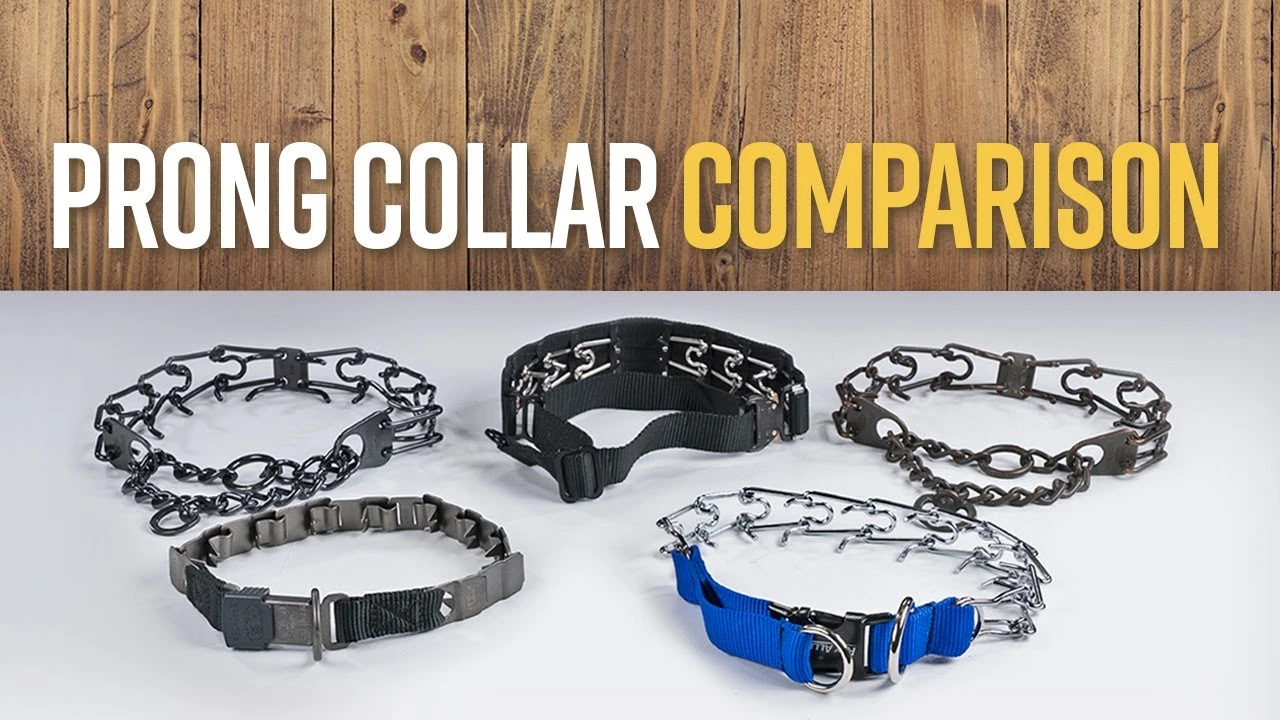
The traditional prong collar features a Martingale-style configuration where both sides of the collar pull together evenly when tension is applied. This design ensures symmetrical pressure around the neck, making it suitable for foundational obedience, heeling corrections, and recall work on high-drive dogs. Available in multiple finishes including stainless steel, chrome, black, and antique, these collars come in a wide range of sizes from Herm Sprenger's full progression to J&J Dog Supplies' smaller options for puppies and compact breeds.
Proper fit remains the single most important factor with any prong collar. The collar should sit high and tight behind the ears, with prongs making contact but not digging into the skin. Handlers must master positioning and timing to communicate clearly without creating fear or avoidance.
How do Herm Sprenger Neck-Tech collars evolve the classic prong design?
The Herm Sprenger Neck-Tech represents a significant evolution in prong collar design, combining the pressure functionality of traditional prongs with a low-profile appearance. These collars maintain the core training effectiveness while offering configurations like cinch (sliding ring), one-pull, and Martingale styles to match different handler preferences and dog temperaments.
A key advantage of the Neck-Tech is its discreet appearance. Once fitted properly, it blends into regular collar territory, making it ideal for public work, demonstrations, or environments where visible training tools might draw unwanted attention from passersby. The sleek profile does not compromise functionality, and the collar can convert to a standard flat collar configuration when training pressure is not needed.
Which prong collars work best for handlers with limited grip strength?
Modern prong collar designs increasingly address handler physical limitations, particularly arthritis or reduced dexterity. Innovations like the ClicLock buckle system paired with nylon Martingale straps create smooth, easy-to-operate mechanisms that eliminate the struggle of manipulating individual prongs. These collars feature ID tag attachment points without noisy metal jingling, maintaining a professional appearance while prioritizing handler comfort.
The quick-release training pinch collar offers slip and dead-ring modes that can be linked together for customized pressure response. This design slips over the head without buckle fiddling, making it accessible for trainers working multiple dogs or those with limited hand strength. For dogs requiring extended wear during specific conditioning phases, these collars balance training effectiveness with practical daily use.
When should a K9 team use covert or quick-release prong collars?
Covert prong collars address the need for training tools that maintain a low visual profile in public or operational environments. These designs hide the prong mechanism while preserving full training functionality, allowing handlers to work dogs in sensitive areas without drawing scrutiny. Quick-release models prioritize rapid on/off capability, essential for trainers rotating between multiple dogs during group sessions or field work.
While traditional prong collars require more manipulation to adjust between dogs, Neck-Tech styles excel for dedicated single-dog sessions where precise long-term positioning matters most. Each design serves specific workflow needs, from high-volume training rotations to extended individual conditioning programs.
Prong Collar Type Comparison for Working Dogs
| Collar type | Best for | Key features | Dog profile | Handler profile |
|---|---|---|---|---|
| Martingale prong | Foundational obedience, heeling, recalls | Even pressure around neck, classic prong links, multiple finishes | Strong working dogs learning leash pressure, green but powerful dogs | Handlers comfortable managing individual prong links |
| Neck-Tech | Public work, demos, handlers avoiding “spiky collar” optics | Enclosed internal prongs within a flat outer band, cinch and Martingale options | Dogs that already understand prong collar communication | Handlers who need discreet control tools in public |
| Accessibility / ClicLock styles | High-volume training, arthritic hands, limited dexterity | Buckle systems, nylon Martingale straps, ID tag attachment with reduced noise | Dogs in regular training rotations or conditioning phases | Handlers who struggle opening and closing traditional links |
| Covert / quick-release | Operational deployments, sensitive environments, multi-dog strings | Hidden prong mechanisms, rapid on/off, slip and dead-ring modes | Dogs working around public scrutiny or moving between training and deployment | Handlers rotating through several dogs per session |
Fitting and Selection Essentials
Regardless of style, prong collar success hinges on three fundamentals:
- High, tight positioning behind the ears for maximum communication effectiveness
- Proper link count matched to the dog's neck size (fewer links for smaller necks)
- Handler timing and release to reinforce desired behavior rather than suppress through discomfort
From military working dogs requiring bombproof reliability to police K9s transitioning between patrol and public access, the right prong collar becomes an extension of the handler's communication system. Proper selection and fitting turn a simple tool into precise behavior-shaping equipment that elevates working dog performance across all disciplines.